
Tips for Choosing the Right Spray Gun: A Guide for Every Project
As any professional in the woodworking and manufacturing industries will tell you, even the most flawlessly constructed components are elevated by a smooth, durable finishing coat — and achieving beautiful results starts with choosing the right sprayer for the job. This paint gun guide covers what you need to know to select a unit that matches your volume of output and typical project requirements.
Match the Gun to Your Primary Projects
The best spray painting gun depends on the type of job you're performing. Some facilities may benefit from having a variety of sprayer types and tip sizes to accommodate a more versatile range of applications.
Three common options for woodworking and manufacturing tasks include:
1. HVLP Spray Guns for Fine Finishing
High-volume, low-pressure (HVLP) guns are a specific type of compressed air-driven sprayer that uses a built-in turbine to atomize the paint. They can deliver larger volumes, but the low pressure keeps the stream easy to control for minimal overspray and high precision. Many facilities choose HVLP guns because they generate less wasted product and make it easier to perform minute-level tasks, even when working with thinner fluids.
Typical uses include:
- Primer application
- Surface preparation
- Detailed painting for complex millwork
- Fine finishing for furniture
HVLP paint guns aren't easily portable, as they require access to compressed air. When sizing your sprayer, keep your jobsite in mind. Higher-volume units with more powerful output may limit work to designated areas with access to larger air supplies and facilities with dedicated finishing stations. These sprayers also need more extensive maintenance and upkeep — thorough cleaning is required after every use to prevent buildup and premature breakdown.
2. Airless Sprayers for Speed and Scale
Airless sprayers also atomize paint into small droplets but rely on fluid pressure instead of compressed air to operate. This design makes them powerful tools for fast, uniform application that you can easily scale as your output fluctuates. They're also more portable than standard air guns that require a compressor. The biggest drawback to consider is the risk of overspray, especially if it's your team's first time using an airless sprayer.
The paint gun's tip, size and pressure dictate flow rate — high pressure is ideal for medium-thickness paints, but these machines generally aren't compatible with high-viscosity fluid. Airless sprayers are suitable if your team needs to finish large batches of similar pieces, such as:
- Interior and exterior doors
- Wall paneling, trim and molding
- Built-in architectural elements
- Wood furniture or products that require a protective coating
- On-site components
If you need to apply coatings to more intricate pieces quickly and uniformly, manual airless sprayers provide more hands-on control during application. Automatic airless models are a better fit if speed and consistency are your top priorities.
3. Air-Assisted Airless Paint Guns for Versatility
Air-assisted airless paint guns combine the precise control and minimal overspray of an HVLP sprayer with the speed and efficiency of an airless unit. Fluid pressure drives its operation, while a stream of compressed air at the cap breaks paint up into more atomized particles. This pattern control makes them a favorite for facilities that prioritize versatility and flexibility, especially for the following use cases:
- Architectural millwork
- Projects requiring a combination of smaller and larger pieces
- Components that require a seamless, tail-free finish
- Commercial and residential interior painting
- Varnish application
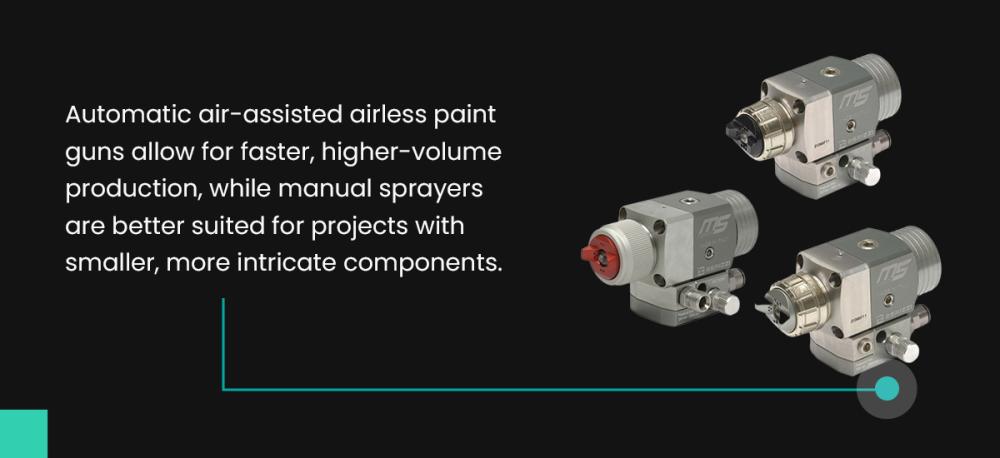
Automatic air-assisted airless paint guns allow for faster, higher-volume production, while manual sprayers are better suited for projects with smaller, more intricate components. You won't get as smooth a finish as you would with an HVLP or standard air gun, but choosing the right size and pattern for the tip will get you close.
3 Key Factors to Consider When Choosing a Spray Gun
Understanding the right gun for your facility's needs is only the first step. You also need to consider which spray tips will help you achieve the desired finish and your jobsite's logistical requirements and capabilities. Many businesses in the woodworking and manufacturing industries are also held to specific emissions-reducing standards.
1. Spray Gun Tip Compatibility
The gun's tip determines the paint sprayer's fan pattern, flow rate and style of application. Flat tips allow for sheet-like application, asymmetrical shapes enable angled spraying for even coatings, and fine or ultra-fine nozzles offer more control.
Always check the manufacturer's sizing and compatibility recommendations before outfitting your sprayer. In general, nozzles with a larger hole have a faster output per minute, but airless sprayers will always be faster than HVLP and other low-pressure air guns.
2. Jobsite Requirements
If you complete any portion of finishing work off-site at different locations, choosing a portable paint sprayer should be your top priority. Look for a unit that is compatible with your typical paint viscosity that balances efficiency with ease of transportation. You should also note the gun's weight — heavier models cause faster operator fatigue, which can impact completion timelines and application quality.
Large-volume production facilities with plenty of space can choose between a standard, non-HVLP air gun or an airless sprayer, depending on the level of detail involved. Small woodworking and furniture companies with less square footage will likely benefit from an airless unit because they don't require access to compressed air, with at least one HVLP in rotation for components that require highly precise work.
3. State and Federal Emissions Regulations
The Environmental Protection Agency (EPA) has strict guidelines regarding hazardous air pollutants (HAPs) and emissions that may apply to your business — contact your state EPA office to see what restrictions apply. In some cases, you may be required to show proof of your facility's plan to reduce or eliminate overspray and other pollutant-causing activities. Choosing a gun with minimal overspray is also better for your bottom line and makes it easier to conduct long-term planning.
HVLP guns are the best option for staying compliant, but certain exceptions can be made with approval. Many suppliers include compliance information in their product listings. You can also reach out to the manufacturer for specific information about your paint sprayer.
Get the Professional Results You Need With KM Coating
Choosing the right paint sprayer ultimately depends on your output volume, the level of detail work involved and your jobsite or facility's limitations. Whether you invest in an HVLP, airless or air-assisted airless gun, achieving a perfect finish requires high-quality tips and accessories.
As a leading distributor of sprayers, tips and accessories, KM Coating has everything you need to create the finishing setup your work deserves at a price that saves you money. Shop our professional-grade inventory today.
Post comments
Leave A Reply
Your email address will not be published.