
Mesh Size vs Micron: What's the Difference? + Conversion Chart
When choosing a paint filter, understanding mesh size and its micron equivalent is essential — and knowing how to convert between the two (like 200 mesh to micron) can help you pick the right filter every time. Both terms can ultimately do the job in telling you how fine a paint filter is; however both terms are quite different from one another.
So what exactly is a micron? Essentially it is a unit of measurement used in determining particle size. Typically the term micron is thrown around for describing extremely small items. To get a better sense of just how small we are talking about, some linear equivalents below will tell the story.
- 1 micron = .0000394 inches
- 1,000 microns = 1 millimeter
- 25,400 microns = 1 inch
So then what does mesh size mean? Mesh size refers to the number of openings per inch of screen, and knowing your mesh size makes it easy to cross-reference the micron equivalent using a conversion chart. If you took the time, all you have to do is count the number of openings in one inch of screen. The total number of openings becomes the mesh size. With that being said, a 30 mesh screen has 30 openings, 100 mesh screen has 100 openings, and so on. Therefore, a high number represents a finer filter.
Bottom line when discussing mesh and micron for paint filters is that they are both talking about how fine the filter truly is. In addition, referencing the mesh to micron conversion chart below, you will see that there is an inverse relationship between each other. The higher the mesh size of something, the lower the number of microns that filter will be.
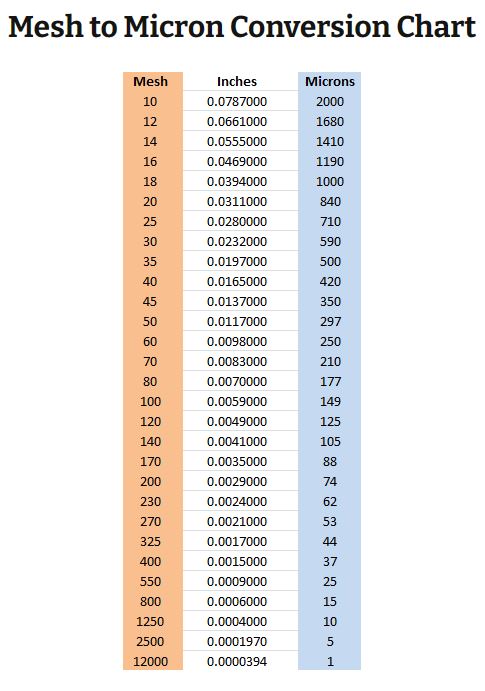
Use this mesh to micron conversion chart as a quick reference. For example, a 200 mesh filter equals approximately 74 microns — a common choice for fine finish applications.
Post comments
Leave A Reply
Your email address will not be published.