
Airless vs. Air Spray Gun: Which System Is Right for Your Job?
Air spray gun vs. airless — which should you choose? Whichever spray technology you select will affect your material costs, labor efficiency and final finish quality. So, it's important to understand these two dominant types and how they're engineered for unique priorities. Airless spray guns excel at raw speed for big, commercial projects, while air spray guns deliver unmatched finish control.
This guide provides the clarity you need to choose the right system for maximum efficiency and profit, whether you need the production power of airless paint sprayer technology or the precision finish of high-volume, low-pressure systems.
The Core Mechanics of High Pressure vs. High Volume
By learning how each spray technology atomizes material, you can gain insight into its strengths and ideal applications. The fundamental difference between high-pressure and high-volume approaches determines factors such as finish quality and production speed.
How Airless Systems Work
Airless spray guns force coating material through a small spray tip at extremely high pressure. This high-pressure approach doesn't require an air compressor to atomize the paint — the pressure itself breaks the material into droplets as it exits the tip.
The result is raw spraying power. Airless systems excel at moving material quickly, handling thick coatings without thinning and covering large surface areas in minimal time. When production speed directly translates to profit, airless technology delivers unmatched efficiency.
How Air Spray Systems Work
Air spray systems using high-volume, low-pressure (HVLP) technology atomize coatings differently. These systems move large volumes of air at low pressure to break the coating into fine droplets.
This method requires a substantial compressor paint sprayer setup but provides exceptional control over the spray pattern and material application. For operations where finish quality determines pricing power, HVLP technology offers precision that justifies the equipment investment.
A Head-to-Head Airless vs. Air Spray Gun Comparison
| Factor | Airless Systems | Air Spray (HYLP) System |
| Finish Quality | Good to great finish — ideal for broad, flat surfaces and production applications | Excellent "Class A" finish quality for automotive, cabinetry and fine furniture |
| Application Speed | Significantly faster coverage. A clear winner for large-scale projects where time equals money. | Slower, more deliberate application suited for detailed work requiring precision |
| Transfer Efficiency | Lower transfer efficiency — creates more overspray and material waste | Very high transfer efficiency, resulting in less wasted material and lower coating costs |
| Coating Thickness | Excels at spraying thick, unthinned materials like latex, primers and industrial coatings. | Best with lower-viscosity materials like lacquers, stains and enamels that require fine atomization. |
| Performance | Maximum production speed with minimal technique requirements for operators | Superior precision and control for quality finishes on detailed work |
| Costs | Higher material consumption offset by faster labor times and reduced equipment complexity | Lower material waste, but requires a larger compressor investment and slower application |
How to Choose Your System
Whether airless or HVLP technology is right for you depends on your operational priorities and the type of work that drives your profitability. When you are evaluating air spray guns vs. airless options, keep in mind that each system excels in distinct ways that align with different business models.
Finish Quality
The finish quality requirements of your primary applications should drive your technology selection:
- Airless: Deliver good-to-great finishes when speed matters more than perfection. High-pressure atomization provides adequate surface smoothness for exterior walls, fences, cabinet interiors and industrial applications where function outweighs the need for a flawless appearance. While capable of delivering excellent results, airless systems may leave a slight texture that's imperceptible in most production applications.
- Air spray: Produce the "Class A" finish quality that defines premium woodworking and custom furniture applications. The controlled, low-pressure atomization creates glass-smooth surfaces with minimal orange peel. This makes HVLP the standard for high-end cabinet faces, fine furniture and any application where finish quality justifies higher pricing.
While premium finish quality often comes with increased equipment costs, the right partner can provide a balance that meets your performance and budgetary needs.
Application Speed
Production speed affects labor costs and overall profitability, making it a crucial factor for high-volume operations:
- Airless: These systems outpace HVLP technology in coverage speed. The high-pressure delivery moves material quickly, making airless spray guns ideal for door manufacturing, large cabinet runs and any application where time correlates to profit margins.
- Air spray: This technology requires slower, more deliberate application techniques that prioritize control over speed. While this reduces hourly production, the precision application often eliminates costly rework and delivers first-pass quality that can command higher pricing in custom applications.
Transfer Efficiency and Waste
Material costs are a significant operational expense, making transfer efficiency a key profitability factor for coating-intensive operations:
- Airless: These systems typically deliver lower transfer efficiency, meaning a percentage of your expensive coating becomes overspray waste. However, the faster application speed often compensates for higher material consumption in high-volume scenarios where labor is the largest cost component.
- Air Spray: HVLP systems offer exceptional transfer efficiency, which can reduce material waste and coating costs. For shops with limited air supply, choosing a low-CFM (cubic feet per minute) spray gun maximizes efficiency while working within compressor limitations.
Coating Thickness
Different spray technologies handle material viscosity and coating thickness differently, affecting which materials you can spray effectively:
- Airless: Excel at spraying thick, unthinned materials directly from the container, including heavy-bodied latex paints, primers and industrial coatings. The high-pressure forces viscous materials through the tip without requiring costly thinners or solvents. This makes airless paint sprayers ideal for applications using thick-film coatings.
- Air spray: This system performs best with lower-viscosity materials like lacquers, stains and enamels, which atomize easily in the low-pressure environment. Professional coat gun applications often require proper material thinning, but the superior atomization of properly formulated coatings creates the smooth finish quality that defines premium applications.
Your Airless vs. Air Spray Gun Selection Checklist
Use this brief checklist to determine which spray technology aligns with your operation.
Choose airless systems if you:
- Prioritize production speed over finish perfection.
- Spray thick materials like primers, latex paints or heavy coatings.
- Need to cover large surface areas quickly.
- Have operators with varying skill levels.
- Operate in high-volume manufacturing environments.
- Can accept lower material transfer efficiency in exchange for greater production speed.
Choose air spray HVLP systems if you:
- Demand premium finish quality.
- Work primarily with lacquers, stains and thin coatings.
- Need maximum material transfer efficiency.
- Charge premium pricing for superior finishes.
- Have experienced operators who value precision control.
- Can invest time in meticulous application techniques.
Still unsure? Many successful operations use both technologies — airless for production work and HVLP for finish coats or premium applications.
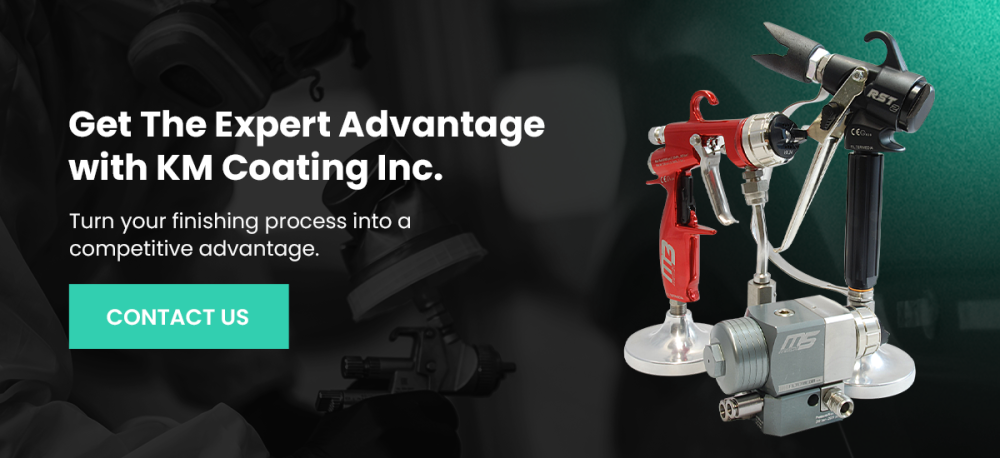
Get The Expert Advantage with KM Coating Inc.
The choice between airless paint sprayers and HVLP becomes clear when you understand your primary application and business priorities. But selecting the right technology is only the first step. Partnering with experts who understand your challenges can be the difference between adequate equipment and optimized profitability.
KM Coating Inc. is a leading distributor of the best spraying technology, engineered to optimize your coating processes. Whether you're delivering showroom-quality automotive work, precision cabinet manufacturing or heavy-duty industrial coatings, we can deliver the professional spray equipment you need. Our expert team has extensive experience helping businesses select the right spray technology to optimize efficiency and finish quality suited to their operations.
Shop our professional-grade inventory, including high and low-pressure pumps, quality high-pressure hoses and a wide range of accessories and supplies. If you have questions, contact our coating specialists who understand your industry challenges. Let us help you turn your finishing process into a competitive advantage.
Post comments
Leave A Reply
Your email address will not be published.